
Doctor:
A young physician capable of providing holistic and comprehensive healthcare services based on the best available evidence, with professionalism, faith, and devotion to God Almighty. They possess strong character, noble morals, ethics, and integrity; embody lifelong learning, social responsibility, and patriotism; and are committed to improving the health and well-being of society.
Decision Maker:
An individual who views situations comprehensively, possesses sharp analytical ability and logical reasoning, and is capable of making quick and accurate decisions.
Communicator:
An individual who communicates effectively and empathetically when explaining matters related to health and other relevant issues.
Leader:
An individual who thinks in a structured manner, upholds integrity, positions themselves appropriately in society, and is able to identify and solve problems by optimizing existing potential to implement programs within the community.
Manager:
An individual with managerial skills who can process information to make better decisions, work effectively in a team, demonstrate social awareness and collaboration, and apply managerial principles in their work.
Researcher:
An individual who thinks critically and creatively, with strong literacy in science, finance, social and cultural contexts, and information technology, enabling them to address complex health problems and compete globally while applying research outcomes for the benefit of society.
Muhsin:
An individual who understands the concepts of iman (faith), Islam, and ihsan (excellence in conduct); applies moral principles in fulfilling their duties; implements Islamic jurisprudence (fiqh) in problem-solving; and collaborates within the framework of sharia (Islamic law).
To become a study program with a strong emphasis on community-based medicine, producing high-quality and dignified doctors who are inspired by Islamic values, and dedicated to serving humanity for the benefit of the ummah, the nation, and the state, in pursuit of becoming a world-class university.
The objectives derived from the mission are to achieve outcomes in the implementation and/or development of: faculty governance reform based on the principles of good governance; a high-quality medical education program characterized by Islamic values; high-standard medical research published at both national and international levels; and community service activities in the health sector aimed at improving public health while fulfilling the faculty’s dakwah (Islamic outreach) mission.
Additionally, the program seeks to strengthen national and international collaborations related to the Tri Dharma of Higher Education—education, research, and community service—and the development of organizational and program management to accelerate the achievement of the Study Program’s Vision, Mission, and Goals.
In carrying out institutional and academic activities, all members of the academic community are bound by the organizational culture of IHSAN—Islami (Islamic), Humanis (Humanistic), Santun (Courteous), Amanah (Trustworthy), and Natural.
Dasar operasionalisasi pencapaian visi-misi adalah pencapaian strategi yang merupakan strategi induk untuk mencapai sasaran strategik meliputi sasaran bidang pendidikan, penelitian, pengabdian kepada masyarakat, tata kelola, sumber daya manusia (dosen, mahasiswa, alumni, staf administrasi), sumber dana, sarana/prasarana dan teknologi informasi, serta kerjasama.
Setiap Sasaran Strategik dicapai melalui sejumlah program yang dijabarkan setiap tahunnya dalam kegiatan/aktivitas yang diukur berdasarkan target/indikator yang jelas, dirumuskan dan ditetapkan dalam tiap rencana operasional tahunan (Renop). Hasil evaluasi diri menunjukkan penyelenggaraan Prodi tetap dalam ruang lingkup dan bingkai pencapaian visi dan misi. Akselerasi pencapaian visi-misi dilakukan dengan menggunakan seluruh kekuatan untuk memanfaatkan peluang dan mengantisipasi tantangan agar tercapai standar visi-misi yaitu Standar Kompetensi Dokter Indonesia (SKDI) dan Standar Nasional Pendidikan Tinggi (SN-Dikti).
The formulation of the Learning Outcomes (Capaian Pembelajaran Lulusan – CPL) for the Professional Doctor Program at the Faculty of Medicine, Universitas Muslim Indonesia (UMI), refers to the legal foundation for Learning Outcome development: Presidential Regulation No. 8 of 2012 concerning the Indonesian National Qualification Framework (KKNI). The KKNI provides a structured framework for aligning, equating, and integrating educational qualifications with training and work experience to recognize competencies in accordance with job structures across various sectors.
Based on this regulation, the Bachelor of Medicine Program is categorized at Qualification Level 6. In addition, the determination of learning outcomes refers to Minister of Research, Technology, and Higher Education Regulation No. 44 of 2015 on the National Standards for Higher Education.
Below are the Learning Outcomes (CPL) for the Professional Doctor Program, Faculty of Medicine, Universitas Muslim Indonesia:
(S1) Devoted to God Almighty and upholding humanity based on Pancasila with full responsibility; internalizing values, norms, and ethics; developing independence, leadership, and responsibility in the field of medicine.
(S2) Possesses a national outlook and practices medicine with strong religious conviction, morality, professional ethics, discipline, legal awareness, and adherence to social norms.
(S3) Demonstrates responsibility in medical practice with independence and a humanistic spirit.
(S4) Acts as a proud and patriotic citizen with a sense of nationalism and responsibility toward the nation and state.
(S5) Respects cultural diversity, beliefs, religions, and opinions, as well as the original findings of others.
(S6) Works collaboratively and shows social awareness and concern for the community and environment.
(S7) Abides by laws and maintains discipline in social and national life.
(S8) Internalizes academic values, norms, and ethics.
(S9) Demonstrates academic behavior grounded in Islamic medical values—being berilmu amaliah (knowledge applied in action), beramal ilmiah (action based on knowledge), berakhlakul karimah (noble character), and highly competitive.
(P1) Mastery of fundamental concepts in medical science.
(P2) Mastery of the principles of Good Medical Practice, diagnostic steps, and management approaches.
(P3) Mastery of basic principles in obstetric and neonatal emergency management.
(P4) Integration of community medicine and Islamic medicine principles within medical science.
(P5) Understanding of the concepts of iman (faith), Islam, and ikhlas (sincerity).
(P6) Integration of Islamic values into medical knowledge and practice.
(KU1) Able to practice medicine in accordance with professional competency standards.
(KU2) Able to logically and systematically manage clinical information in diagnosis and treatment management.
(KU3) Able to produce innovative scientific works through logical, critical, and systematic thinking, adhering to scientific ethics and published in accredited journals.
(KU4) Able to produce innovative, tested, and beneficial work for the profession and society.
(KU5) Able to critically evaluate their own and peers’ work and decisions.
(KU6) Able to enhance medical expertise through lifelong learning and professional experience.
(KU7) Able to lead a team in solving professional medical problems.
(KU8) Able to develop interprofessional collaboration and maintain professional networks.
(KU9) Responsible for professional conduct in accordance with the code of ethics.
(KU10) Able to improve learning capacity independently.
(KU11) Able to manage information technology and monitor/evaluate work programs for medical professional development.
(KU12) Able to perform promotive, preventive, and educational activities in public health.
(KU13) Able to implement medical knowledge and skills grounded in Islamic values.
(KK1) Able to perform medical practice professionally in accordance with divine, moral, ethical, disciplinary, legal, socio-cultural, and religious principles at local, regional, and global levels in managing individual, family, community, and public health problems.
(KK2) Able to practice medicine with self-awareness of limitations, manage personal challenges, continuously update knowledge for patient safety, and contribute to medical advancement.
(KK3) Able to obtain and exchange information effectively, both verbally and nonverbally, with patients of all ages, families, communities, colleagues, and other professionals.
(KK4) Able to utilize health information and communication technology in medical practice.
(KK5) Able to solve health problems based on the latest scientific foundations in medicine and health to achieve optimal outcomes.
(KK6) Able to perform clinical procedures safely and effectively, applying principles of patient safety, self-safety, and public safety.
(KK7) Able to manage individual, family, and community health problems comprehensively, holistically, and sustainably within the context of primary healthcare.
(KK8) Able to apply and implement medical knowledge and skills based on Islamic creed (aqidah), morals (akhlaq), and law (sharia).
----
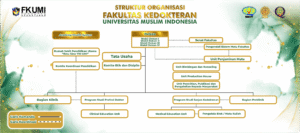
Anatomical Pathology Department
Head: dr. Djumadi Achmad, Sp.PA(K), Sp.F
Secretary: dr. Denny Mahius, S.F., M.Kes
Internal Medicine Department
Head: dr. Indah Lestari Dg. Kanang, Sp.PD
Secretary: dr. Prema Hafsari, Sp.PD
Radiology Department
Head: dr. Erlin Syahril, Sp.Rad(K-TR)
Secretary: dr. Febie Irsyandi, S.Ked., Sp.Rad
Neurology Department
Head: dr. Moch. Erwin Rachman, M.Kes., Sp.N(K)
Secretary: dr. Achmad Harun, Sp.N
Psychiatry Department
Head: dr. Irma Santy, Sp.KJ
Secretary: dr. Ilma Khaerina, Sp.KJ
Dermatology and Venereology Department
Head: Dr. dr. Sri Vitayani, Sp.KK
Secretary: dr. Lisa Yuniarti, Sp.KK
Surgery Department
Head: dr. Reeny Purnamasari, M.Kes., Sp.B., AIFO-K
Secretary: dr. Berry Erida Hasbi, Sp.B
Anesthesiology Department
Head: Prof. dr. H. Andi Husni Tanra, Sp.An(KMN), Ph.D
Secretary: dr. Faisal Sommeng, Sp.An-KIC
Ophthalmology Department
Head: Dr. dr. Marliyanti N. R. Akib, M.Kes., Sp.M(K), MHPE, FFRI
Secretary: dr. Hanna Aulia Namira, Sp.M
Pediatrics Department
Head: Prof. dr. Djhauhariah A. Madjid, Sp.A(K)
Secretary: dr. Sidrah Darma, Sp.A
Otorhinolaryngology-Head and Neck Surgery (ENT) Department
Head: dr. Andi Baso Sulaiman, Sp.THT-KL(K), M.Kes
Secretary: dr. Andi Tenri Sanna, M.Kes., Sp.THT-KL
Obstetrics and Gynecology Department
Head: Dr. dr. Trika Irianta, Sp.OG., Subsp.Urogin-Re
Secretary: dr. Anna Sari Dewi, Sp.OG
Public Health, Community, and Preventive Medicine Department (IKM-IKK-IKP)
Head: Dr. dr. Rachmat Faisal Syamsu, M.Kes
Secretary: dr. Hj. Dahlia, MARS
Cardiology Department
Head: dr. Wisudawan, M.Kes., Sp.JP., FIHA
Secretary: dr. Nurhikmawati, M.Kes., Sp.JP., FIHA
Orthopedic Department
Head: dr. Andi Dhedie Prasatia Sam, Sp.OT(K)
Secretary: dr. Andi Fadil Mula Putra, Sp.OT
Medical Education Development and Innovation Department (IDIK)
Head: Dr. dr. Ida Royani, M.Kes., MHPE, FFRI
Secretary: dr. Nurfadillah Khalid, M.Biomed